Scars That Remain: A sermon on John 20:19-31
@thespeakingpillow
Ohhhh, Thomas. Oh, Thomas Thomas Thomas. I do love you.
Thomas is one of my favorite disciples. Thomas, who in John 14’s famous passage where Jesus declares that he is going to a place to which the disciples cannot follow, asks, “But Lord, how do we know the way?” Thomas, who was separate from the group when the amazing Upper Room ghostie Jesus appears. Thomas, who declares he is just too skeptical about the resurrection and must see for himself the living Christ. Thomas, whose heart had been torn by watching his friend die, by hiding from the empire, by the loss and grief he was feeling...and so he just had to check for himself whether it was really Jesus alive again.
Thomas, who asks questions. Thomas, whose doubt was not in opposition of faith, as has been told us for hundreds of years, but whose doubt was rooted in his faith and love of his friend and savior.
Friends, this scripture that describes the post-resurrection appearance of Jesus is so relatable. Who hasn’t experienced doubt, of their faith or of the power of a relationship or about their own self? Who hasn’t said “I need proof” when something seems too good or too awe-filled to be true? And who among us doesn’t have scars of our own?
One of the most profound details of this story is that Jesus’ resurrected body retained the scars of his crucifixion. The marks of empire’s violence were still with him. His experiences in his earthly body were still with him. He was still himself, but perhaps more fully so, as his body did the gentle and powerful work of incorporating his experiences into his flesh...and healing him. The story of resurrection does not suggest that he was given a so-called “perfect” body without blemish—which is good because a “perfect” or “normal” body does not exist! So we can stop body shaming right there!
Duke Divinity School professor, theologian and writer Dr. Kate Bowler writes, “We bear all the ruins of the lives we’ve lived and the loves we’ve endured. What a gift to have a Savior who does the same.”1
Scars are incredible. They tell stories of our lives, our experiences, events that have shaped who we are. Scars show that we are capable of healing, and that our bodies are powerful not because we can endure suffering, but because we can develop scar tissue. Scar tissue is strong and thick, forming as skin literally knits itself back together again, as flesh repairs itself. Scars may fade over time, but they are never completely gone.
Of course, scars are not only on the outside. Emotional and mental and spiritual scars are also parts of us, though we do not bear the physical markings of them. They also inform who and how we are in the world.
During this Lenten season, as I read through Cole Arthur Riley’s This Here Flesh, I found myself thinking about scars. Cole, writing as a young Black woman, recounted painful parts of her family’s history, referencing plainly abuse, assault, trauma, discrimination, bigotry, poverty that have literally shaped her DNA. She also wrote about the history of white Europeans enslaving her African ancestors, and white USAmericans continuing histories of colonization and bigoted treatment of Black people over generations. These happenings have also caused scars—some physically passed down from generation to generation, such as higher susceptibility to cancers, blood disorders, malnutrition complications. And emotional and mental scars that have formed through hundreds of years of oppression...and spiritual scars, as Christianity in particular was used to justify white Europeans’ enslavement of African and Indigenous peoples. These scars are all real, and are passed down yet today, not only in story but in the way some folks’ DNA is expressed and what chemical signals are triggered in people’s brains and hearts.
Cole Arthur Riley writes, “Trauma changes the body. Some research suggests that it leaves its mark on our genes, a mark that can be inherited from generation to generation. This transference does not altogether surprise me, as I am among those who believe that we are made of our histories, that no part of me is untouched by the glories and traumas that gave birth to me. But a certain helplessness comes over me when I truly consider that I might be affected not only by my present pain but also by the agony of my ancestors. Though I would never wish away my connection to those who endured and resisted violence and exclusion, I have to contend with what their stories are doing to my body. And I tremble to think what parts of my storied blood will flow through the bodies of any children I have.”2
This is why we must engage in the work of antiracism, the individual and communal and theological work that leads toward racial justice. People of color bear the scars of hundreds of years of oppression.
White European-descended people bear the scars of those who perpetrated that oppression. All of our wellness and wholeness depends on what we do once we see and acknowledge the scars we bear.
In the last chapter of This Here Flesh, Cole Arthur Riley writes using the language of “generational curses” to help readers understand that in many ways, we create liberation. It is not inevitable. She says, “For those whose ancestors bore great evil into the world—which may very well be all of us—the curse is only passed as you participate in it. It is our responsibility to know and own the stories that have made us in such a way that we forsake the curse. This requires a scared humility, or humans quite readily accept their place in the glories of their ancestors but remain woefully unwilling to accept the connection to their ills. But it is precisely our failure to acknowledge the curses we’ve benefited from that keeps us from full liberation.”3
Beloveds, it is possible to heal. Scars show us that. We bear scars because there have been things that have torn our flesh, ripped our emotions, rended our minds in ways that continue to affect us today. But the scars are there because we have survived—you have survived. You are still here, and you are a miracle. We must share the stories of our scars with one another, and we must receive these stories with humility for the gifts they truly are. Then we must learn from the stories how we heal each other, and how we heal our world.
Scars are scars because they are no longer open wounds. Because they have been given time to heal. Because the place of wounding was given rest without bother, was covered and comforted, and because the body in its infinite and intimate wisdom began to repair itself and did that slow, gentle, powerful work in the dark. Scars are strong, scars show healing, scars are part of us, and we should not be ashamed of them...but we must know what they are, what they are from, how those places of past pain show us who we are and how we are to live today. As Benjamin Alire Saenz writes in his critically acclaimed queer coming-of-age novel, Aristotle and Dante Discover the Secrets of the Universe, “Scars. A sign that you had been hurt. A sign that you had healed.”
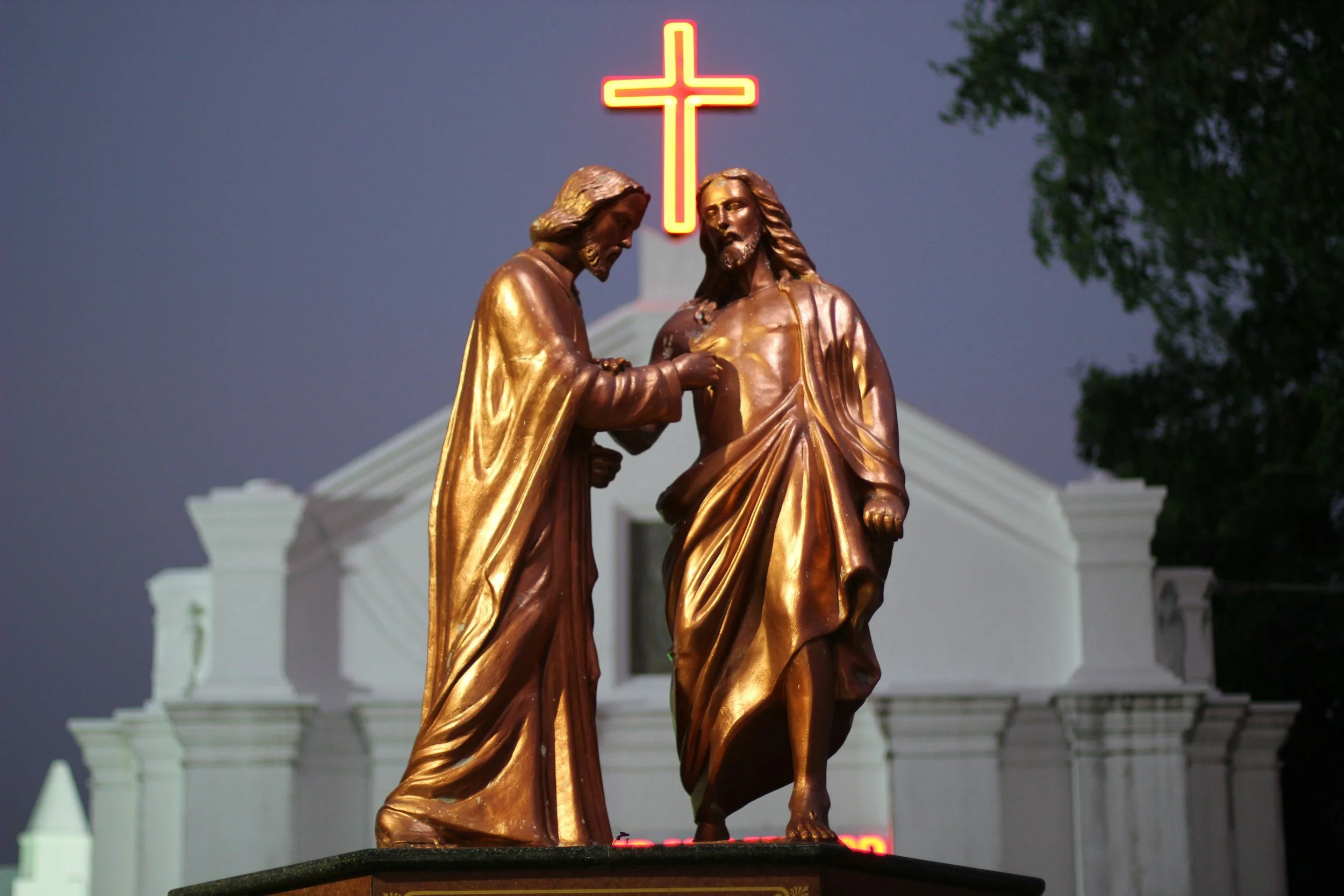
I like to think that when Thomas took hold of Jesus’ hands and feet and saw where the nails had pierced the flesh and where the sword had cut his side, that he wept not only because he was able to confirm it was his friend appearing before him, but because he had scars, too. Maybe Thomas’ scars were physically appearing on his body, or maybe they were internal scars from his life experiences and emotional pain. But Thomas was so moved by seeing these scars on the risen Christ that he declared aloud that the Holy was among them. The Holy who had lived as they had lived, had died as they would someday die; who carried the evidence of trial and trauma in his flesh; who knew intimately the pain of grief and loss. The scars remained, and that was Good News to Thomas.
May it be so to us all.
April 16, 2023