What I Have Learned About Peace: A Sermon
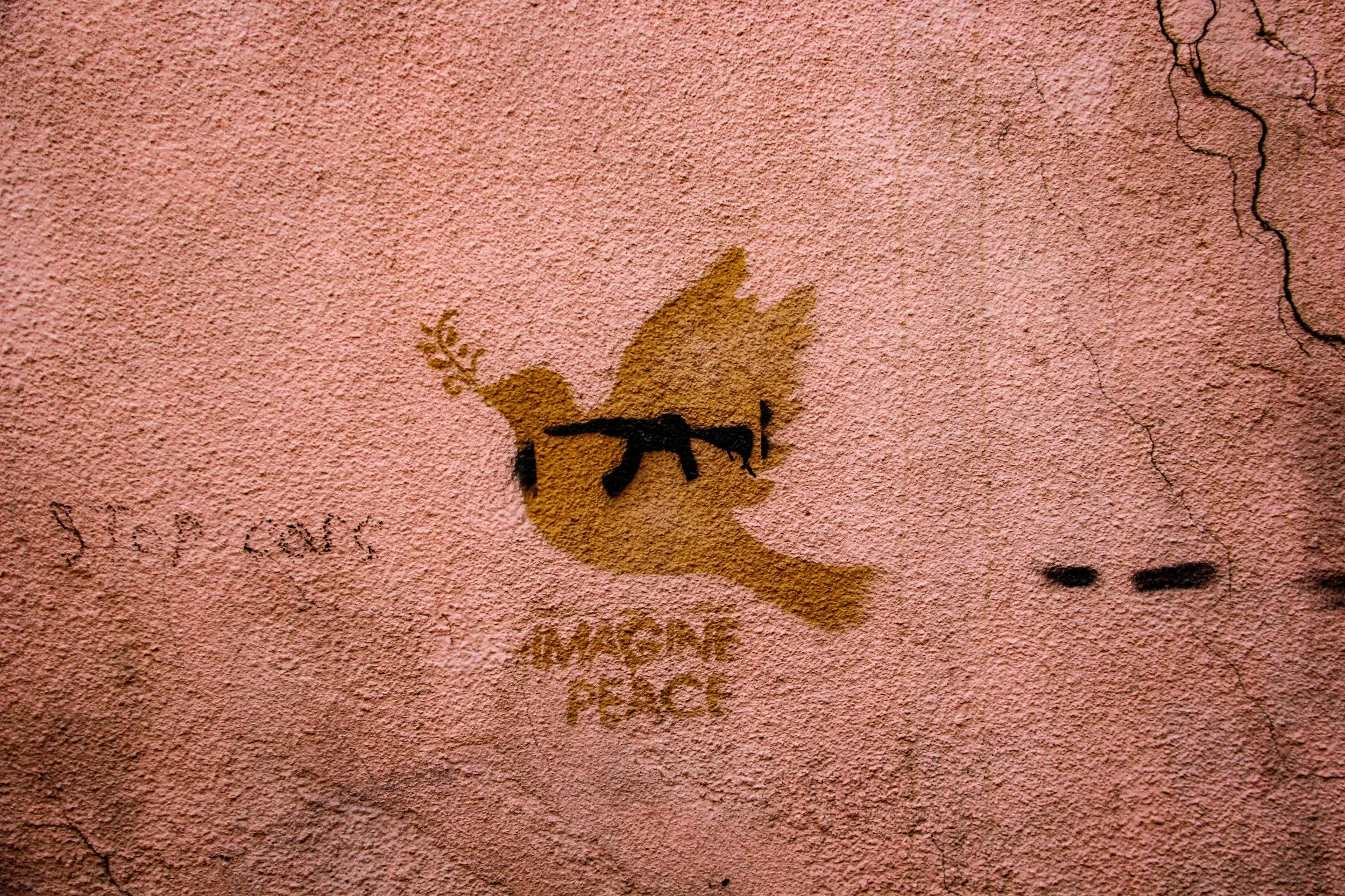
Image from Unsplash @zaur_ibrahim
Are you a peacemaker? Am I a peacemaker? Are we peacemakers, together?
“Peacemaker” might sound like a great big word with a great big weight attached to it. We think of exceptional people like Rev. Dr. Martin Luther King, Jr., Mahatma Ghandhi, Nelson Mandela, Archbishop Desmond Tutu, Malala Yousafzai, Mother Theresa, and more when you think of “peacemakers.” Or maybe you think of those faces and stories of our own Seattle First Baptist church family who adorn the walls of our aptly titled “Peacemaker’s Room”: Judge Charles Z. Smith, Rev. Robert Walker, Alice Franklin Bryant, Dr. Harold Jensen, Dr. Elmer Friddell.
What would it take to think of yourself as a peacemaker?
When I was in college, I didn’t think of myself as a peacemaker. I understood the concept of peace through justice. I felt called to show up in times of distress in our world and in my community, to witness for a better way of being. I tried to learn how to mend conflict, how to find a middle way, how to bring differing sides to a common understanding underlaid by common values. But I wasn’t a peacemaker.
Then, in the summer of 2014, I drove myself to St. Catherines, Ontario, Canada to attend my first summer conference of the Baptist Peace Fellowship of North America. This annual gathering is affectionately called “peace camp” by those who attend. Though I was aware of BPFNA through my college church, I had never participated myself in the organization. But in 2014 I had been invited to attend because the focus was on the theme of “One Creation,” and environmental justice, a particular area of meaning and research for me.
What I learned in this gathering of scrappy, hippie, dissenting, courageous, flamboyant Baptists was that I am a peacemaker. And I’d venture a guess that you are, too, in some way. All those who seek a peaceful way through life, all those who value the call of Micah 6:8 to do justice and love mercy and walk humbly with God, all those who have tasted justice just to have it snatched away and yet they keep on going...all those folks, all you folks, are peacemakers.
So today, as we uplift the work of the Baptist Peace Fellowship of North America~Bautistas por la Paz, I want to share with you what I have learned about peace from my last nine years of involvement with this beloved organization.
Peace is something we create together.
It is no secret that we live in a world in conflict. Violence, death, destruction are all around us: wars, genocide, gun violence, disappearance of children and women, the detainment of people at the borders of ours and many countries, missing and murdered indigenous women, the vicious assault on the rights of transgender people...the list goes on and on.
And yet...there are people in each of these struggles working slowly but surely for the cessation of conflict, the dignity of all people, and the presence of justice. Maybe when you hear the oft-quoted Mr. Rogers saying “look for the helpers” in times of crisis and you are tempted to roll your eyes. But it’s true. Look for the helpers. They are there, in their small corner of the world, doing what they can with what they have at that time.
BPFNA is an organization made up of individual members, family groups, church communities, organizational partners and denominational associations who all work together, bringing their diverse gifts and social positions to put pressure on the forces that dominate and oppress. From a tiny seminary in Chiapas, Mexico to a bishop in the Republic of Georgia to a small church in Novia Scotia to a solo member in the middle of Utah...people are doing the work of telling truth to power to chip away at the walls that divide us and define our world. People often say that the summer Peace Camp is like a breath of fresh air, because people come together and remind each other that they are not alone...and that’s enough to keep them going a while longer.
Peace can only come through justice.
There is too much at stake in the world to settle for a “false peace” that is just the status quo but plus enforced peace, or coerced peace. That's not true peace. In the prophetic books of the Hebrew Bible, the prophet says that people call “peace, peace!” but there is no peace. And today we continue that call. For a true peace to be present, one in which all persons are valued and their dignity respected; one in which the Creation no longer groans with labor pangs of what may come; one in which the forces of division and oppression no longer have the loudest voices and are quickly called in to change their ways...for this type of peace to be present, justice must be done.
Because peace is not passive.
There is a point in everyone’s life, and in every conflict, where we have a choice: to go along with “how things have always been done,” to “just do a job and get along,” or to take a stand, to show up, to assert your values clearly and courageously. We may wonder, thinking of those famous peacemakers I mentioned earlier, how they had the courage to stand tall against oppression and evil? They were rooted in their values, they knew who they were, they knew what they were up against, and they believed that it didn’t have to be this way.
At the Global Peace Conference in Colombia in 2019, where Doug and Janet and I were blessed to attend, along with other Evergreen Region family members, we heard stories from those who worked closely on the Colombian Peace Agreement that was ratified in 2016 and has since been challenged. Families of those killed by the Colombian army and by the guerrilla groups and by paramilitary groups told of how they endured the horrific violence, torture and murder of loved ones, and still maintained a belief that peace could triumph...and that they wanted to be a part of it. This was not some simple, superficial idea of peace—but peace rooted in an understanding that the people of Colombia were strong and would find a way to come to an agreement to end the longest-running conflict in the Americas.
Peace is hard-won.
As we all know, some of us very personally, lives have been lost in pursuit of peace. When the status quo of any established system is challenged, the system pushes back—often violently. To give a recent, and ongoing, example, think of what some call the “white-lash” of Trump’s election and the public rise of Christian nationalism in this country following Barack Obama’s presidency. As a young adult in the early 2010s, I was sure that this country was going in a positive direction, sure that the president was the best of what we could be, sure that we were moving upward in the spiral of history...and then Michael Brown’s murder happened. And then Sandra Bland. And then Trump was elected. And then Charlottesville happened.
A white-lash, a backlash against the public dignity of Black people (and BIPOC), the success of those on the margins.
When I found myself wondering what could be done, what could I do, one place I turned was BPFNA. I served six years on the Board as a young adult, and as part of serving the organization in that way I saw up-close how an institution dealt with the crises-of-the-moment, in which we felt called to speak up and take a public stance based in our values.
And we tried. We did the best we could. We called together a working group called Centering Black Lives that we hoped would show BPFNA our reflection as an institution made up of mostly well-meaning, white progressive Christians...as well as lead us into doing justice and supporting Black Lives Matter.
But, as Brooke knows all too well, as an early member of that Centering Black Lives group, the organization had a lot to learn. Were we well-intentioned? Yes. Did we have a long history of good work for peace? Yes. Were we prepared to give ourselves an honest look, to deal with the consequences of that gap between intent and impact, to grow and change without seeing change as a threat? That remained to be seen.
Because peace takes sacrifice.
For the white folks in BPFNA, and I know this because I am a white person and I was on the Board, so we heard plenty from them, not all of us were ready to have the real conversations about whether the organization was ready for racial justice work. There were biases in individuals and in our organizational structure that we had to address. The white folks among us had to do some uncomfortable reflection on whether we were actually welcoming to people of color? Whether we tokenized our siblings of color and our Spanish-speaking siblings as we invited them to preach and pray among us? We had to think about the locations in which our conferences were held—do conferences held in rural areas feel safe for our siblings of color?
I learned that working for peace requires a sacrifice of my self-image. Perhaps for others it is a different sacrifice. But I had to confront the ideas of supremacy and moral goodness that were embedded in my psyche in a new way. And the organizational leadership had to let go of the ego of our storied history that had roots in American Baptist pacifist movements around WWII.
How did we do this? Or really, I should say, how does BPFNA, or any organization, come through that challenging process of reflecting such that we see the ugly and difficult aspects of how we must change?
Well, peace takes creativity.
To work through conflict, find solutions that work for multiple people with differing ideas, to be willing to depart from the safety of “how we’ve always done it” ...that takes creativity. It requires that we free ourselves from the confines of social norms and standard ideas, that we find space to listen to the artist and the poet and the child coming into their identity. Peace requires that we listen, deeply...and that we let our listening impact us, deeply.
And peace is persistent.
Ask Philip, working for LGBTQIA+ rights in Uganda. Ask Doris, working for environmental justice in the face of pollution in Puerto Rico. Ask Allison, pastoring a church in Oakland who are advocates for justice in Palestine. Ask Ray and Adalia, who pastored for years in Tijuana with migrants seeking asylum in the USA. Ask Waldemar, pastoring amidst intense poverty in Cuba. Ask Mary and Steve, whose former church, the church that formed me, still holds a weekly peace vigil on the corner of College and Main in Oberlin, Ohio.
Peace is persistent...it comes up through the cracks in the walls of oppression and injustice like that annoying dandelion that just won’t give up. Because peace can’t give up. It must be achieved, because people’s lives depend on it. Creation’s life depends on it. How we treat each other depends on it.
Like our indigenous family remind us, we must think seven generations ahead, and know that we may be planting the seeds of trees that we will never sit under. But it is still worth it to plant the seeds.
Beloved church, if rooted in the justice of the Holy, peace is something that is everlasting. Peace is mentioned in the Bible over 300 times. Peace is something the Holy One gives to us and leaves with us, it is a way of being that will prepare the way for God’s kin-dom. As followers of the Way of Jesus, we ought to pay attention to peace. And the way toward peace is the path of justice...for every person and all Creation to live abundantly together.
Seattle First Baptist Church
May 21, 2023